

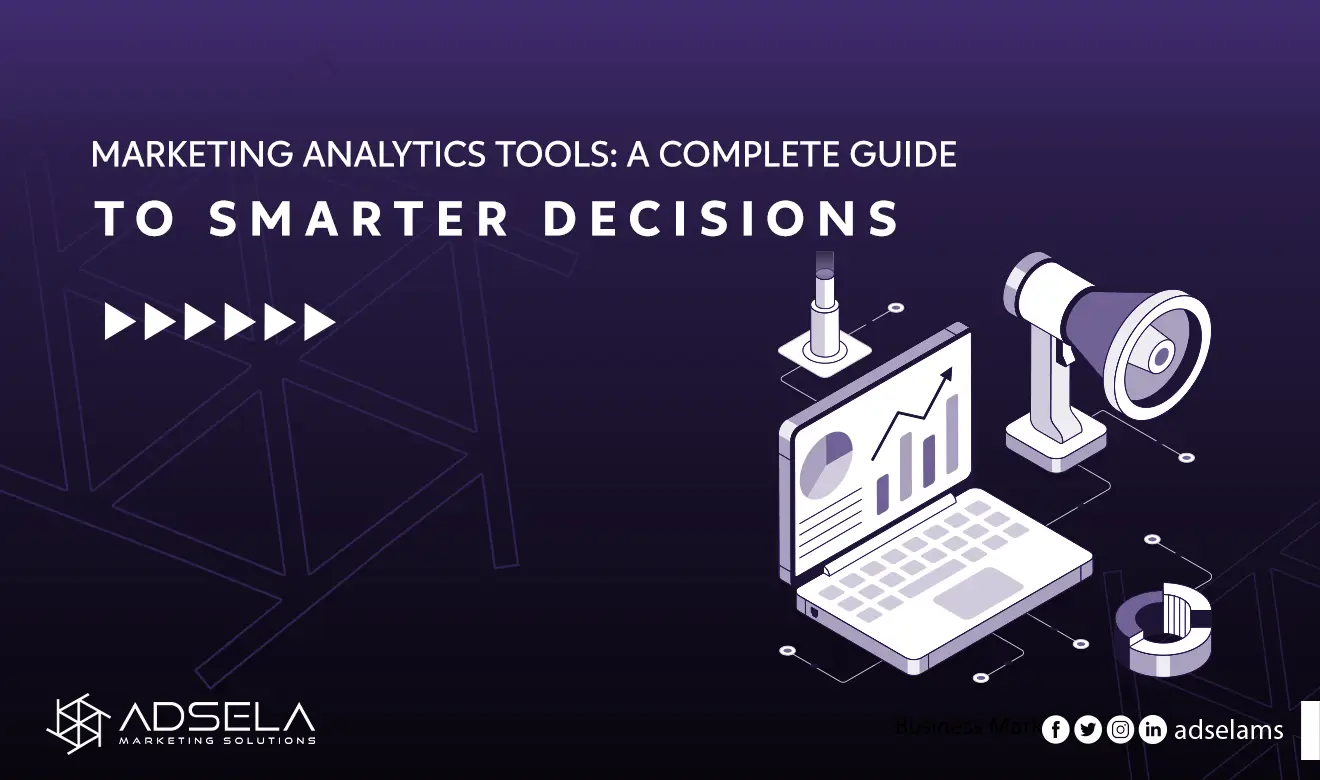
Marketing Analytics Tools will enable businesses to convert raw marketing data into actionable insights to support smarter decision-making, more effective campaigns and better returns. These days, businesses can gather data from search engines, advertising, social media, websites, e-mail promotions, and CRM systems. If this information isn’t effectively organized and interpreted, important opportunities are lost. Useful marketing analytics tools help to make performance easier to understand by ensuring that important information is consolidated in one place. When it comes to measuring KPIs, comparing campaigns, finding trends, and deciding where money will be best spent to achieve business goals, they come in very handy. They can also ease client reporting and help these agencies report campaign results easily.
What Are Marketing Analytics Tools and Why Do They Matter?
Marketing analytics tools are the software that gather, categorize, analyze, and show the information created through marketing. They assist companies to determine campaign efficiency, customer actions, visitor sources, conversions, and marketing expenses.
They are important because making assumptions in marketing can result in lost budgets and opportunities. There can be campaigns that lead to a lot of traffic and not many leads, and there can be campaigns that lead to less traffic but much higher conversion rates.
Marketers can make decisions based on evidence by analysing these differences. Marketing tools also enable teams to keep an eye on how they are performing over time and help them see if their marketing efforts are gaining momentum toward desired business objectives.
How Do Marketing Analytics Tools Help You Make Smarter Business Decisions?
Marketing analytics tools transform the information from campaigns into measurable insights, making it easier for businesses to make smarter decisions. Unlike relying on individual platform reporting, marketers can compare channels and gain insight into what’s happening and how their efforts are impacting performance overall.
A business can, for instance, look at paid search, organic search, social media and email marketing and evaluate their performance with respect to the traffic and conversions they can generate. This data will then help shape future budget allocations and campaign strategies.
These can also be used to find out which campaigns are not performing well, high-value audiences, successful landing pages, and shifts in customer behavior. If the marketer continually monitors these insights, he can make strategic moves while small problems don’t turn into big ones.
Which Marketing Metrics Should You Track for Better Campaign Performance?
The metrics that help you the most will be based on your business model and campaign goals. There are some KPIs that are especially useful in the measurement of marketing performance, however.
| Marketing Metric | What It Measures |
| Website Traffic | The number of visitors reaching your website |
| Conversion Rate | The percentage of visitors completing a desired action |
| Cost Per Lead | The average cost of generating a lead |
| Customer Acquisition Cost | The cost of acquiring a customer |
| ROAS | Revenue generated from advertising spend |
| Click-Through Rate | How frequently users click an advertisement or link |
| Engagement Rate | How audiences interact with content |
| Customer Lifetime Value | The expected long-term value of a customer |
| Revenue | The financial results associated with marketing activity |
How Can Marketing Analytics Tools Improve Your ROI?
Businesses can use marketing analytics tools to help them determine where their marketing spend is most effective and thus maximize ROI. Campaign costs and conversions and revenue can be compared by the marketer which helps him/her make informed decisions regarding investment.
The paid advertising is a good example. If a campaign has a good click-through rate but few customers are following through from the click, the ROI from the campaign may be minimal. This difference can be identified through analytics and can help marketers focus on creating content that will make a difference, not just for engagement.
It’s the same with SEO, social media marketing, email marketing and content marketing. This tracking allows companies to determine which marketing efforts are not generating conversions or sales, and direct more resources toward more effective campaigns.
What Features Should You Look for in Marketing Analytics Tools?
Businesses need to take into account the usability and functionality of marketing analytics tools. A platform should help to make it easier to understand and act on data, not more complex.
Important features include:
- Multi-channel data integration
- Customizable dashboards
- Automated reporting
- KPI monitoring
- Campaign comparison
- Conversion tracking
- Data visualization
- Historical performance analysis
- Client reporting
- Advertising platform integrations
- CRM integrations
- Data at the current time and/or regular updates.
Customizable reports can be particularly valuable to marketing agencies. Each client has its own set of goals; therefore, agencies must be able to emphasize the appropriate KPIs and also show campaign performance clearly.
How Do Marketing Analytics Tools Integrate with CRM, Advertising, and Website Data?
The modern marketing analytics tools can integrate the data from various sources such as CRM systems, advertising platforms, websites, social media, and other marketing technologies.
CRM integration can be used to link campaigns with leads and customers. Advertising integrations can give information on spend, clicks, impressions and conversions. Traffic sources, user behaviour and conversions can be displayed in website data.
When all these sources are integrated together, a comprehensive view of the customer journey emerges. Marketers can view traffic and leads as a whole, rather than separating them out.
Marketing tools are especially useful for companies that are running multiple digital channels.
How Can Real-Time Marketing Analytics Improve Campaign Performance?
Real-time marketing analytics provides businesses with more insight into campaign performance during the campaign. This can assist marketers in spotting sudden changes and reacting rapidly.
For instance, if conversion costs are raised drastically, marketers can explore the campaign and find out if anything needs to be adjusted. Once a specific landing page begins to generate better conversion rates, the team can see that trend and then invest more of them into that particular page.
Real-time data should be used with caution, however. Not all of the short-term variations need immediate response. The usefulness of marketing analytics tools is heightened when they are used to compare actual outcomes with the goals of a marketing campaign, the past performance of the business, and market conditions.
How Do You Choose the Right Marketing Analytics Tools for Your Business?
The first step in selecting the best marketing analytics tools is to determine what information your business requires. Think about who you are doing it for, what your KPIs are, how you will be reporting, how you will integrate, team capabilities, and budget.
Before choosing a platform, consider:
- Is it compatible with the marketing channels used?
- Can it connect with our CRM and advertising platforms?
- Does it offer the KPIs required?
- Can dashboards and reports be customized?
- How accessible is the platform to our team?
- Does it scale along with growth in our marketing efforts?
- Is it worth its price?
If agencies are looking for a consolidated marketing reporting solution AgencyAnalytics may be considered. It has a platform built for agencies to bring marketing data together and generate tailored reports for clients.
Simplify Your Marketing Reporting With AgencyAnalytics
Want to simplify your marketing reporting and bring your campaign data together?
Explore AgencyAnalytics and discover a more centralized approach to marketing performance reporting.
Why Is Adsela the Right Partner for Marketing Analytics and Performance Optimization?
Marketing analytics tools are only valuable when it comes to the interpretation and use of the data. While analytics will provide information of what is going on, businesses still need a strategy for finding out why things are changing and what should be done next.
Adsela can help in building a digital marketing strategy that can leverage performance data for optimizing. When businesses consider these factors, they can gain a more comprehensive view of their digital marketing results, and optimize their strategies as needed.
With data-driven decision-making, the opportunities can be identified, wasteful spending minimized, campaigns optimized, and marketing efforts properly targeted to business goals.
By leveraging the right strategy and marketing tools, businesses can transform data from a task into a taskmaster, empowering them to make more informed marketing decisions.